






















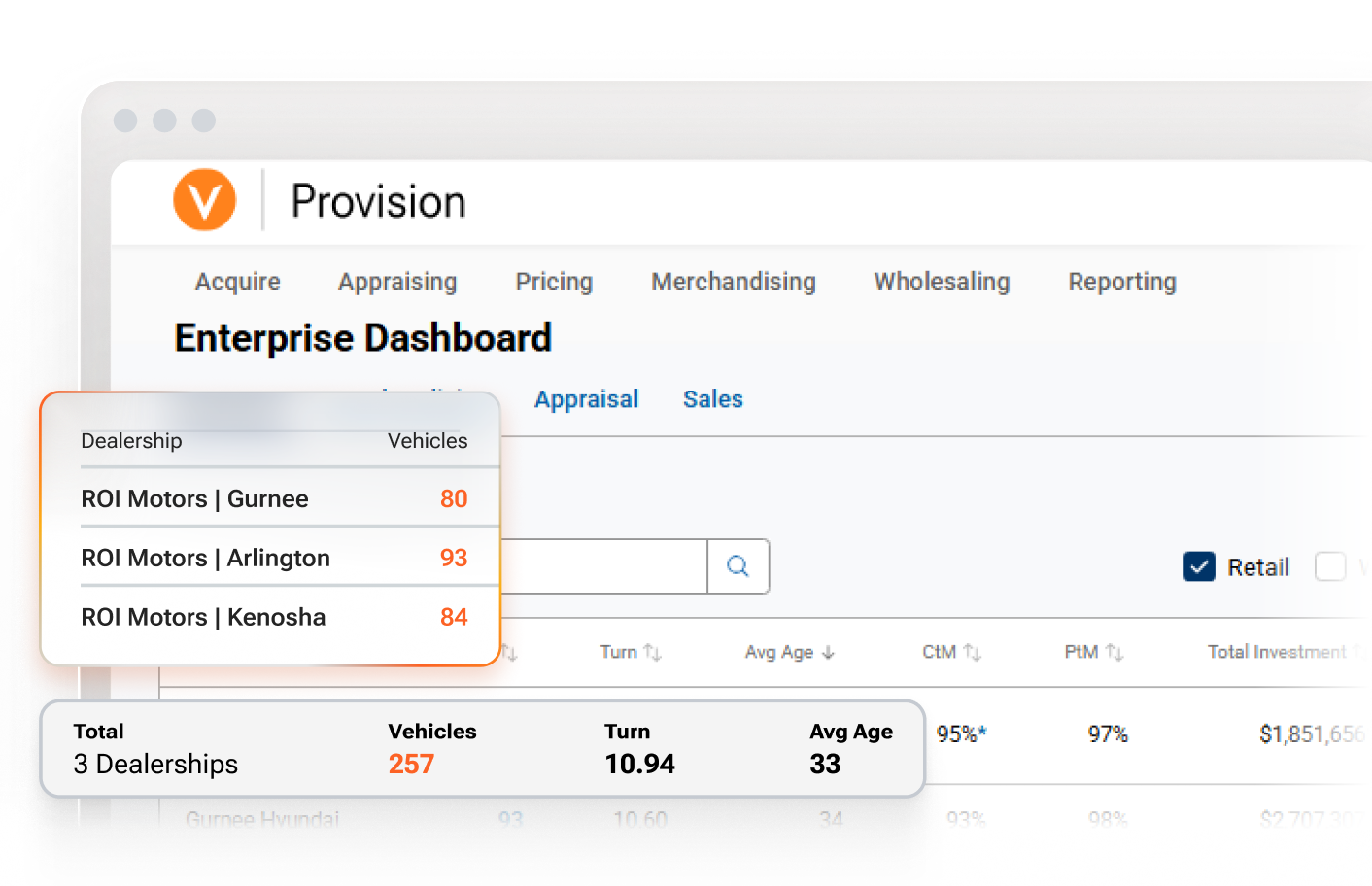
Summary: As dealer groups grow, inventory decisions become more complex. Discover how a group-wide approach to inventory management can help leaders identify opportunities, understand market dynamics, and make better-informed decisions across rooftops.
Managing more rooftops creates more inventory opportunities, but it can also make it harder to identify issues and act consistently across stores. With a connected enterprise view, dealer groups can identify issues sooner, align inventory with demand, and take action across stores using real performance data.
Identify Where Attention Is Needed
A dealer group may have hundreds or even thousands of vehicles spread across several markets, making it challenging to spot trends by reviewing stores one by one.
With an enterprise view, leaders see inventory performance across the group in one place. Instead of gathering information from individual rooftops, they can quickly identify which locations, vehicle segments, or inventory categories warrant a closer look.
For example, a group-level view may reveal:
- One rooftop carrying a higher concentration of aging inventory, while another turns similar vehicles more quickly.
- Pricing performance varying significantly between stores.
- A particular segment underperforming across multiple locations.
This approach can also create a common starting point for conversations between group leadership and individual stores. When everyone is working from the same inventory, pricing, sales, and aging data, you can focus discussions on performance rather than spending time gathering information.
vAuto Enterprise Reporting gives dealer groups one view of inventory, sales, pricing, and aging metrics across rooftops, making it easier to identify where attention may be needed.
Determine What’s Driving the Issue
Aging inventory does not necessarily indicate a stocking problem. The problem could stem from pricing strategy, vehicle mix, local demand, or a combination of factors.
By comparing inventory and sales information across rooftops, group leaders can begin to identify patterns that may not be visible at the store level. Reviewing metrics such as inventory age, discount averages, trade over/under averages, and sales performance can provide additional context for understanding how each dealership is trending.
Market comparisons can add another layer of insight. A vehicle that appears difficult to sell at one rooftop may simply be out of alignment with local demand. Comparing inventory against what is selling in the market can help leaders determine whether factors such as make, model, price, color, trim, or body style are contributing to slower performance.
Just as important, a group-wide view can help distinguish between isolated issues and broader trends. If multiple rooftops are experiencing the same challenge, the root cause may be larger than a single store’s inventory strategy. If only one location is affected, leaders can focus their attention on the specific conditions influencing that market.
Within vAuto Enterprise Reporting, dealer groups can compare inventory, sales, and available market insights to better understand the factors influencing performance. For new-vehicle dealer groups, vAuto Conquest can supplement enterprise reporting with market insights that help distinguish store-specific challenges from broader inventory opportunities.
Take Action Across Rooftops
Comparing dealer day’s supply with market day’s supply can help reveal inventory imbalances. If a rooftop is carrying more of a particular vehicle than local demand supports while another location has stronger demand for that vehicle type, it may be worth considering an internal transfer. Instead of treating inventory as separate store-level pools, dealer groups can evaluate inventory as a shared resource and make decisions based on where each vehicle is most likely to succeed.
This approach can also help groups avoid relying solely on discounting to address aging inventory. While price adjustments may be appropriate in some situations, moving a vehicle to a market where demand is stronger may provide a better path forward. Internal transfers can also help reduce the need to source additional inventory when another rooftop already has vehicles that better fit local demand.
At the same time, group-level visibility should not replace local expertise. Store leaders often have valuable knowledge about customer preferences, competitive conditions, and market dynamics that may not be fully reflected in reporting. The most effective decisions combine centralized insights with the experience and judgment of the teams closest to the market.
By helping groups identify inventory imbalances across rooftops, vAuto can support transfer, pricing, and stocking decisions informed by both market conditions and store-level expertise.
Make Scale an Operational Advantage
The advantage of scale is not simply owning more rooftops. It comes from managing inventory as a connected resource while still accounting for the realities of each market.
Dealer groups that can manage inventory with a broader view of performance are often better positioned to capitalize on the benefits of growth without losing sight of local market dynamics.
vAuto Enterprise Reporting and enterprise inventory management tools help bring these insights together, giving dealer groups a shared view of inventory performance across rooftops.
See how vAuto can help your dealer group make more connected inventory decisions.